

Dr. Celso Gontijo
Chairman of the Board
Former president of ABMS (Brazilian Association for Soil Mechanics and Geotechnical Engineering)
70 years of experience in geotechnical engineering
CREA/CONFEA 1404864105
Verification of the tensile load capacity of piles, anchors and helical anchors.
The static tensile load test is a geotechnical test that Geoteste performs worldwide to prove the resistance of foundation elements subjected to pull-out forces.
Request a QuoteThe test verifies the tensile load capacity of foundation structures, piles, single-bar anchors and helical anchors that must resist pull-out forces.
Essentially, the test consists of the programmed application of increasing tensile loads according to the design. Generally, loading proceeds in stages until reaching twice the working load, as recommended by NBR 16903:2020. During this process, at each new load stage, we precisely measure the structure's displacements using properly calibrated dial gauges.
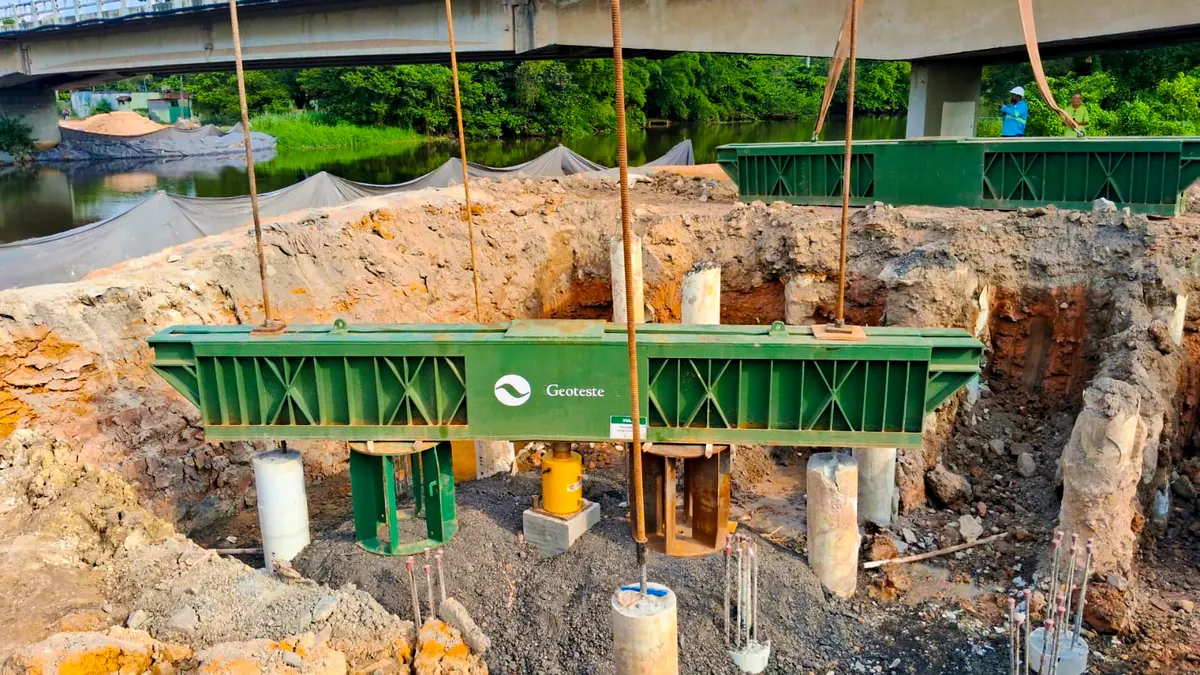
Tension load testing follows a rigorous procedure to ensure reliable results. Although every project has its own requirements, the main steps are as follows.
Assembly of a robust structure, usually steel beams, capable of resisting the applied loads without deformations that could affect the results.
Dial gauges or transducers positioned at the top of the foundation element, with an initial zero reference reading.
Slow and controlled application of the tensile load by the hydraulic jack, in increments of approximately 25% of the working load.
Readings at predetermined intervals until displacement stabilizes, before each new load increment.
Unloading in stages to assess the foundation's elastic response and any permanent displacements.
This test is fundamental for projects with structures subjected to uplift or overturning forces. Its most common applications include foundations for large roofs, hangars, structures with hydrostatic uplift, and foundation elements requiring proof of pull-out resistance.
Real estate
Mining
Energy
Industrial
Infrastructure
Sanitation
Logistics
Oil and gas
Agribusiness
Load x displacement curve
Pile or anchor load capacity
Settlement at the working load
Pile foundation safety factor
All results are compiled in a detailed technical report signed by a specialist engineer, including the load versus displacement curve, load capacity calculations and interpretation by our engineering team.
Allows verification of the load versus deformation curve at the design load.
For projects with more than 100 piles, load tests are required under the applicable Brazilian criteria.
The results provide evidence for assessing the safety of the project's foundation.
A team of highly qualified engineers and specialists, prepared to develop safe and efficient solutions for the most diverse geotechnical challenges.
Chairman of the Board
Former president of ABMS (Brazilian Association for Soil Mechanics and Geotechnical Engineering)
70 years of experience in geotechnical engineering
CREA/CONFEA 1404864105
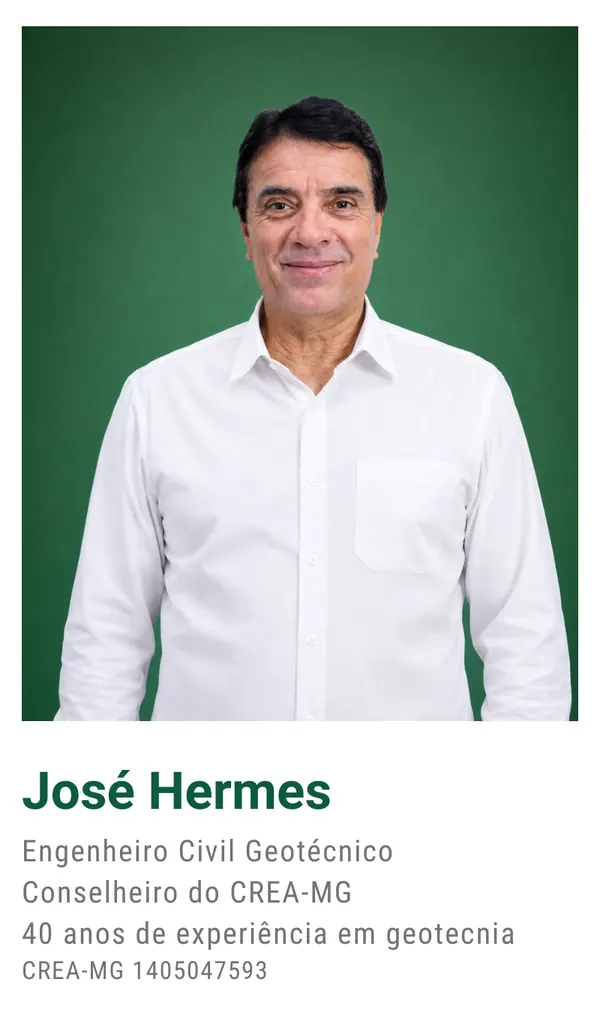
Geotechnical civil engineer
Board member of CREA-MG (regional engineering regulatory body in Brazil)
40 years of experience in geotechnical engineering
CREA/CONFEA 1405047593

Technical Director
Geotechnical civil engineer
30 years of experience in geotechnical engineering
CREA/CONFEA 1404815503

Executive Director
Geotechnical civil engineer
26 years of experience in geotechnical engineering
CREA/CONFEA 1416959840

Geotechnical civil engineer
11 years of experience in geotechnical engineering
CREA/CONFEA 1417059923

Geotechnical civil engineer
10 years of experience in geotechnical engineering
CREA/CONFEA 1416378065

Business and Operations Manager
Geotechnical civil engineer
3 years of experience in geotechnical engineering
CREA/CONFEA - 1423584910

Commercial Manager
Geotechnical civil engineer
9 years of experience in geotechnical engineering

Geotechnical civil engineer
5 years of experience in geotechnical engineering
CREA/CONFEA 1420099566

Geotechnical civil engineer
6 years of experience in geotechnical engineering
CREA/CONFEA 1423765745

Geotechnical civil engineer
6 years of experience in geotechnical engineering
CREA/CONFEA 1421107996

Geotechnical civil engineer
7 years of experience in geotechnical engineering
CREA/CONFEA 1418234362

Geotechnical civil engineer
2 years of experience in geotechnical engineering
CREA/CONFEA 1422269183

Geotechnical civil engineer
1 year of experience in geotechnical engineering
CREA/CONFEA 1423530080

Geotechnical civil engineer
6 years of experience in geotechnical engineering
CREA/CONFEA 1422452557

Geotechnical civil engineer
3 years of experience in geotechnical engineering
CREA/CONFEA 1421602407

Geotechnical civil engineer
2 years of experience in geotechnical engineering
CREA/CONFEA 1422908925

Geotechnical civil engineer
2 years of experience in geotechnical engineering

Geotechnical civil engineer
2 years of experience in geotechnical engineering

Geotechnical civil engineer
1 year of experience in geotechnical engineering
We combine decades of experience, a qualified team, and in-house technology to deliver tests with technical rigor.
Mobilization of our teams and equipment for projects worldwide.
Cutting-edge technology and rigorous maintenance.
Engineers with extensive experience.
Efficient planning and fast responses.
Customized technical solutions.
ART and compliance with technical standards.
Rely on those who understand the subject.
Talk to a specialist now and request a customized technical proposal for your project.
Talk to an engineer