
Understand where the foundation resists
Shows how the load is transferred to different soil layers and how much is mobilized in the shaft and tip.
No more guessing where the pile resists. Measure the real load, layer by layer.
Instrumented SLT combines controlled static loading with sensors at different foundation levels to reveal load transfer in depth and increase the safety of design decisions.
Request technical proposalLoading follows the logic of a static load test, but instrumentation adds readings at different depths of the foundation element.
Strain sensors, usually strain gauges, record the material response at defined levels along the shaft. An acquisition system transforms these readings into strain data, allowing the calculation of internal load in each section and the construction of the load transfer diagram.
In concrete piles, sensors are installed on the reinforcement before pouring. In steel piles, installation is done on the element itself. The instrumentation project is developed according to the pile, soil profile, and the technical question the test must answer.
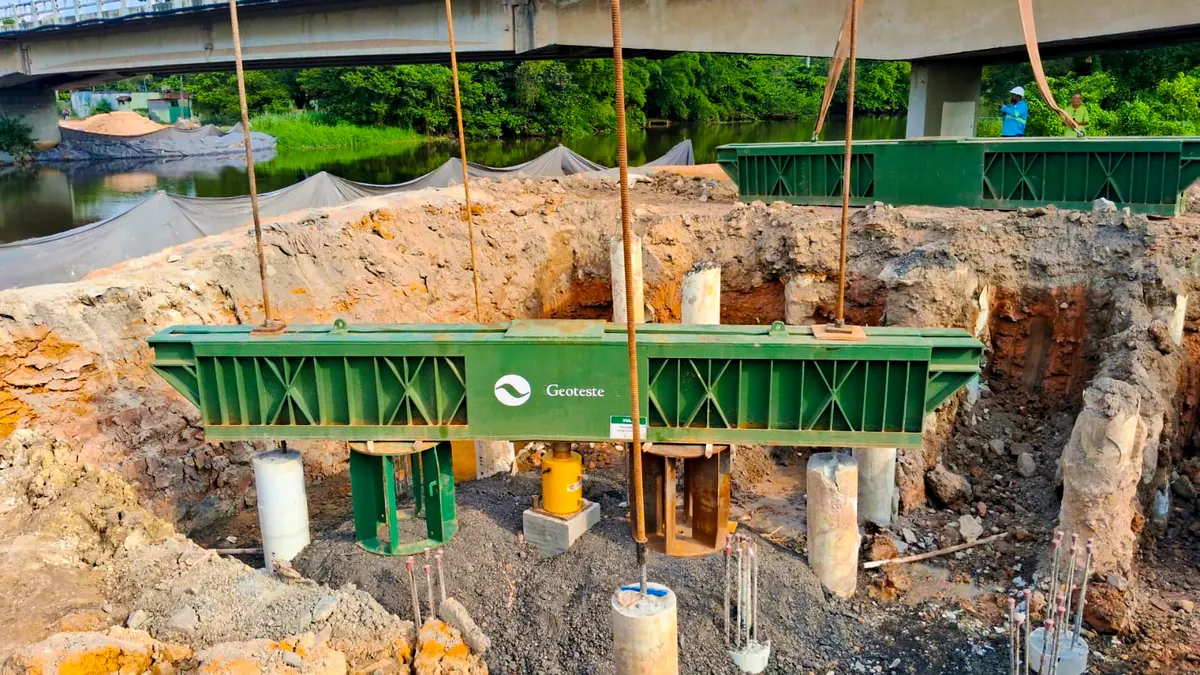
Distributed reading shows how resistance is mobilized along the foundation, offering a view that exclusive top measurement cannot separate.
Shows how the load is transferred to different soil layers and how much is mobilized in the shaft and tip.
Complements the load x settlement curve with internal information not obtained through top readings alone.
Allows comparison of field-measured behavior with geotechnical predictions and sizing methods.
Provides data to evaluate solution performance and support potential optimizations with technical responsibility.
Both methods evaluate foundation behavior under static loading. The difference lies in the quantity and depth of the information collected.
| Analysis | Conventional static load testing | Instrumented static load testing |
|---|---|---|
| Primary measurements | Applied load and settlement at the top | Load and settlement at the top, plus strains at multiple levels |
| Main result | Load x settlement curve | Load x settlement curve and load transfer diagram |
| Shaft friction and tip resistance | Global response, without direct separation | Estimation of portions mobilized in the shaft and tip |
| Planning | Assembly and instrumentation concentrated during the test | Sensors and cabling planned before pile execution |
The choice depends on the project objective. The Geoteste team evaluates the need for instrumentation and defines the appropriate reading levels for each foundation.
Definition of reading levels along the shaft according to pile geometry, geotechnical profile, and analysis objectives.
Positioning of sensors on the reinforcement of concrete piles or directly on the element for steel piles.
Assembly of the reaction structure with reaction piles, tiebacks, anchors, or a loaded platform, according to the test design.
Incremental load application with measurements of pile head displacements and strains at instrumented levels.
Conversion of strains into internal forces to interpret how the load is distributed between the shaft and the tip.
Real estate
Mining
Energy
Industrial
Infrastructure
Sanitation
Logistics
Oil and gas
Agribusiness
Load x settlement curve at the top
Load transfer diagram in depth
Skin friction distribution along the shaft
Load portion mobilized at the tip
Internal load at instrumented levels
Strain records during loading
Electrical strain gauges are commonly used to measure strains at multiple levels along the pile. Readings are processed by a computerized data acquisition system and converted into internal loads based on the properties of the instrumented element.
Fiber optic sensors can also be adopted when the project requires multiple reading points and a specific cabling architecture. The technology is defined after technical evaluation, considering the executive method, foundation geometry, and test objectives.
A team of highly qualified engineers and specialists, prepared to develop safe and efficient solutions for the most diverse geotechnical challenges.

Chairman of the Board
Former president of ABMS (Brazilian Association for Soil Mechanics and Geotechnical Engineering)
70 years of experience in geotechnical engineering
CREA/CONFEA 1404864105
Geotechnical civil engineer
Board member of CREA-MG (regional engineering regulatory body in Brazil)
40 years of experience in geotechnical engineering
CREA/CONFEA 1405047593
Technical Director
Geotechnical civil engineer
30 years of experience in geotechnical engineering
CREA/CONFEA 1404815503

Executive Director
Geotechnical civil engineer
26 years of experience in geotechnical engineering
CREA/CONFEA 1416959840

Geotechnical civil engineer
11 years of experience in geotechnical engineering
CREA/CONFEA 1417059923
Geotechnical civil engineer
10 years of experience in geotechnical engineering
CREA/CONFEA 1416378065

Business and Operations Manager
Geotechnical civil engineer
3 years of experience in geotechnical engineering
CREA/CONFEA - 1423584910

Commercial Manager
Geotechnical civil engineer
9 years of experience in geotechnical engineering

Geotechnical civil engineer
5 years of experience in geotechnical engineering
CREA/CONFEA 1420099566

Geotechnical civil engineer
6 years of experience in geotechnical engineering
CREA/CONFEA 1423765745

Geotechnical civil engineer
6 years of experience in geotechnical engineering
CREA/CONFEA 1421107996

Geotechnical civil engineer
7 years of experience in geotechnical engineering
CREA/CONFEA 1418234362

Geotechnical civil engineer
2 years of experience in geotechnical engineering
CREA/CONFEA 1422269183

Geotechnical civil engineer
1 year of experience in geotechnical engineering
CREA/CONFEA 1423530080

Geotechnical civil engineer
6 years of experience in geotechnical engineering
CREA/CONFEA 1422452557

Geotechnical civil engineer
3 years of experience in geotechnical engineering
CREA/CONFEA 1421602407

Geotechnical civil engineer
2 years of experience in geotechnical engineering
CREA/CONFEA 1422908925

Geotechnical civil engineer
2 years of experience in geotechnical engineering

Geotechnical civil engineer
2 years of experience in geotechnical engineering

Geotechnical civil engineer
1 year of experience in geotechnical engineering
Reliable results begin with the definition of measurement levels and continue through the combined interpretation of pile response, the geotechnical profile and the foundation system.
Technical mobilization for projects worldwide.
Equipment, reaction systems, and instrumentation managed by a specialized team.
Geotechnical civil engineers present from planning to results interpretation.
Grupo Gontijo's experience applied to foundation quality control.
Instrumentation plan defined to answer technical questions for each project.
Execution, analysis, and report with technical responsibility and record traceability.
Plan instrumentation before pile execution.
Talk to a Geoteste engineer and receive a technical proposal suited to the foundation and your project objectives.
Talk to an engineer